Your GPUs run only as fast as the operating system under them
RLC Pro AI tunes the layer between your accelerators and your models. The CIQ Linux Kernel tracks the upstream long-term kernel, so new accelerators run the week you rack them. CUDA, DOCA-OFED, and PyTorch ship validated together, and the same stack runs on bare metal, in the cloud, and as an OCI container. Move a workload to wherever it runs cheapest or fastest. Enterprise Linux binary compatibility.
CIQ trusted by:
RLC Pro AI delivers more from every GPU by optimizing the layer that drives it all: the OS
Start with a validated stack
Day-one hardware support
More output from every GPU
What's in RLC Pro AI
Enterprise Linux, enhanced with AI/ML workload optimizations, that deliver leading performance for your AI workloads with a golden, validated image that makes scaling fast and repeatable.
CIQ Linux Kernel (CLK)
Pre-validated stack
Deployment flexibility
Ships as a container
Faster model loading, workload-tuned scheduling
Ready-to-run workloads
Enterprise security and support
Enterprise Linux binary compatibility
Pin a known-good stack across your GPU fleet
CIQ Enterprise Linux Manager (ELM) comes with all RLC Pro subscriptions. Mirror and curate content for your GPU and CUDA nodes, pin the exact versions that work, and stage the next before it touches production. A bad driver bump rolls back in one move.
CIQ trusted by:
Built for what comes next
RLC Pro AI ships the pre-built, pre-tuned stacks your AI/ML workloads require today. Deploy on bare metal, virtual machines, OCI containers, or immutable images through bootc. What's next: the Ollama container post and immutable substrates for Warewulf and Fuzzball.
Find the right edition
Rocky Linux | RLC+ NVIDIA | RLC Pro | RLC Pro Hardened | RLC Pro AI | |
|---|---|---|---|---|---|
| Enterprise Linux binary compatibility | |||||
| Bundled GPU drivers (NVIDIA, AMD) | |||||
| CUDA Toolkit / DOCA-OFED | |||||
| Long-Term Support (LTS) | |||||
| FIPS 140-3 validated packages | |||||
| Bug fixes | |||||
| Indemnification | |||||
| Enterprise support SLAs | Requires purchase of Standard or Premium support | ||||
| Kernel runtime protection (LKRG) | |||||
| Automated STIG / CIS compliance | |||||
| AI / HPC kernel optimization |
| Capabilities at a glance | |
|---|---|
| Compatibility | Binary compatible with Enterprise Linux |
| Architectures | x86_64, aarch64 |
| GPU acceleration | NVIDIA CUDA Toolkit, DOCA-OFED, GPU drivers |
| Networking | RDMA and InfiniBand via DOCA-OFED |
| Kernel | CIQ Linux Kernel (CLK), built from upstream kernel.org longterm |
| Cloud | AWS, Azure, GCP |
| Formats | ISO, KVM and cloud images, OCI container images, and bootc images |
| Supply chain | CIQ-built, cryptographically signed, SBOM shipped with each image |
| Licensing | Annual subscription, per-node pricing (not per-GPU) |
Deployed with confidence. Backed by CIQ.
Secure supply chain
Support from experts
Indemnification
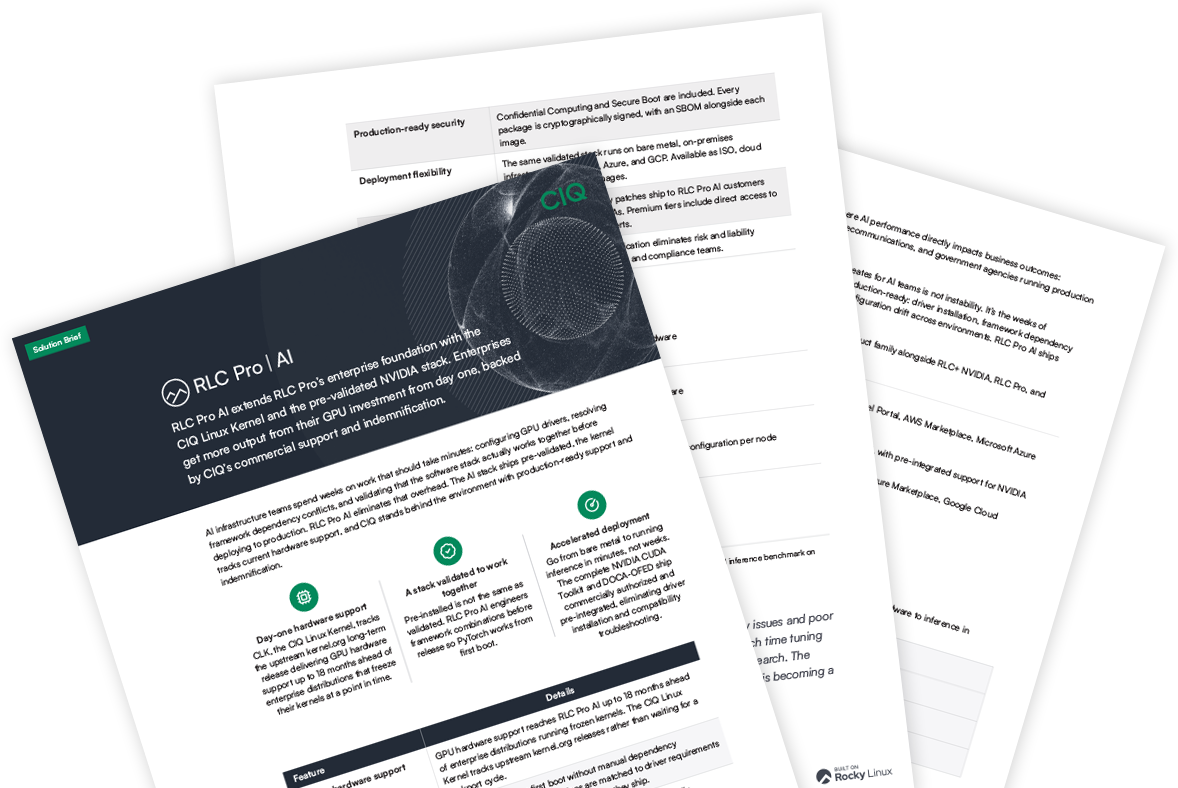
Learn more in the RLC Pro AI guide
Frequently asked
The CIQ Linux Kernel (CLK), currently the upstream 6.18 long-term series. CLK tracks the upstream long-term kernel instead of a frozen snapshot kept alive by backports, so GPU hardware support arrives as upstream delivers it.
No. CLK pairs with the Rocky Linux userspace, so applications certified for Rocky Linux run unmodified. Only the kernel changes.
Yes. It ships as OCI container images on x86_64 and aarch64, with GPU access from the host through the NVIDIA Container Toolkit and CDI. A container by itself doesn't make a GPU fast — run it on RLC Pro AI and the containerized stack gets the same tuned, validated performance as the bare-metal and VM builds. bootc brings that same stack to immutable, image-based deployment.
Yes — it's one of the two situations teams arrive from. Moving GPU workloads back on-premises is a solid use case for RLC Pro AI. You get one validated stack across bare metal, virtual machines, cloud, and containers, so the workload moves without a re-platforming project. Licensing is per node, not per GPU, so what you own is predictable as the fleet grows.
Annual subscription, per node, not per GPU. Adding GPUs to a node doesn't raise the software bill.
No. The CLK kernel is not FIPS 140-3 validated. FIPS 140-3 validated cryptographic modules are available on the RLC Pro LTS line — route FIPS requirements there. Kernel runtime protection and automated STIG and CIS compliance belong to RLC Pro Hardened. Teams running mixed estates often combine editions under one commercial relationship.
It's built on the RLC Pro commercial foundation and sits alongside RLC+, RLC Pro, and RLC Pro Hardened. Long-Term Support and FIPS are RLC Pro capabilities; kernel runtime protection and automated STIG and CIS compliance belong to RLC Pro Hardened.
CUDA Toolkit, DOCA-OFED, and PyTorch are rebuilt and benchmarked against the shipped driver and kernel before release, then ship pre-integrated and cryptographically signed. The assembly work happens before the image reaches your cluster, not at deployment.
Still have questions?